
Skip to content
FacebookTwitterLinkedinYouTubeGitHubSubscribeEmailRSS
Close
Beyond Knowledge Innovation

Beyond Knowledge Innovation

Where Data Unveils Possibilities

  • Home
  • AI & ML Insights
  • Machine Learning
    • Supervised Learning
      • Introduction
      • Regression
      • Classification
    • Unsupervised Learning
      • Introduction
      • Clustering
      • Association
      • Dimensionality Reduction
    • Reinforcement Learning
    • Generative AI
  • Knowledge Base
    • Introduction To Python
    • Introduction To Data
    • Introduction to EDA
  • References
HomeImplementationNeural NetworksLow-Rank Factorization
Neural Networks

Low-Rank Factorization

October 21, 2024October 21, 2024CEO 613 views

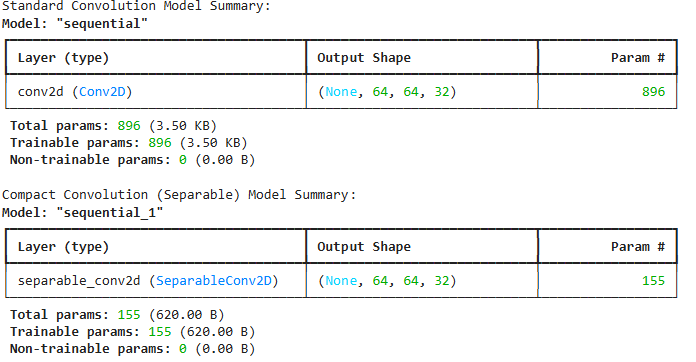
The key idea behind low-rank factorization is to replace high-dimensional tensors with lower-dimensional tensors. One type of low-rank factorization is compact convolutional filters, where the over-parameterized (having too many parameters) convolution filters are replaced with compact
blocks to both reduce the number of parameters and increase speed.

import tensorflow as tf
from tensorflow.keras.models import Sequential
from tensorflow.keras.layers import Conv2D, SeparableConv2D

# Define input shape
input_shape = (64, 64, 3)  # For a 64x64 image with 3 color channels (RGB)

# Model with standard 3x3 convolutional filter
model_standard = Sequential([
    Conv2D(32, (3, 3), input_shape=input_shape, padding='same', activation='relu')
])

# Model with compact convolution using separable filters
model_compact = Sequential([
    SeparableConv2D(32, (3, 3), input_shape=input_shape, padding='same', activation='relu')
])

# Summary of both models
print("Standard Convolution Model Summary:")
model_standard.summary()

print("\nCompact Convolution (Separable) Model Summary:")
model_compact.summary()
factorization, low-rank

Post navigation

Previous Post
Previous post: Perturbation Test for a Regression Model
  • Recent
  • Popular
  • Random
  • No image
    2 years ago Low-Rank Factorization
  • No image
    2 years ago Perturbation Test for a Regression Model
  • No image
    2 years ago Calibration Curve for Classification Models
  • No image
    March 15, 20240Single linkage hierarchical clustering
  • No image
    April 17, 20240XGBoost (eXtreme Gradient Boosting)
  • No image
    April 17, 20240Gradient Boosting
  • No image
    May 9, 2024Gradient Descent Optimization
  • No image
    April 29, 2024Quantile-based discretization of continuous variables
  • No image
    March 4, 2024Classification metrics: Accuracy, Precision, Recall, and F1-score
  • Implementation (55)
    • EDA (4)
    • Neural Networks (10)
    • Supervised Learning (26)
      • Classification (17)
      • Linear Regression (8)
    • Unsupervised Learning (11)
      • Clustering (8)
      • Dimensionality Reduction (3)
  • Knowledge Base (44)
    • Python (27)
    • Statistics (6)
June 2026
M T W T F S S
1234567
891011121314
15161718192021
22232425262728
2930  
« Oct    

We are on

FacebookTwitterLinkedinYouTubeGitHubSubscribeEmailRSS

Subscribe

© 2026 Beyond Knowledge Innovation
FacebookTwitterLinkedinYouTubeGitHubSubscribeEmailRSS