
Skip to content
FacebookTwitterLinkedinYouTubeGitHubSubscribeEmailRSS
Close
Beyond Knowledge Innovation

Beyond Knowledge Innovation

Where Data Unveils Possibilities

  • Home
  • AI & ML Insights
  • Machine Learning
    • Supervised Learning
      • Introduction
      • Regression
      • Classification
    • Unsupervised Learning
      • Introduction
      • Clustering
      • Association
      • Dimensionality Reduction
    • Reinforcement Learning
    • Generative AI
  • Knowledge Base
    • Introduction To Python
    • Introduction To Data
    • Introduction to EDA
  • References
HomeImplementationSupervised LearningClassificationReceiver Operating Characteristic (ROC) and Area Under Curve…
Classification

Receiver Operating Characteristic (ROC) and Area Under Curve (AUC)

March 5, 2024March 5, 2024CEO 432 views
The term “Receiver Operating Characteristic” (ROC) originated in the field of signal detection theory during World War II. Initially, it was used to analyze and measure the performance of radar receivers.

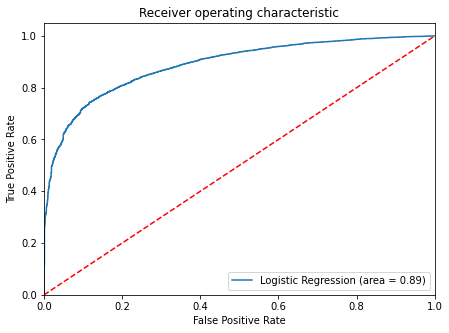
The ROC curve, in Machine Learning, is a graphical representation that illustrates the trade-off between true positive rate (sensitivity) and false positive rate (1 – specificity) across different thresholds for a binary classification model. AUC represents the degree or measure of separability, while ROC is a probability curve.

The ROC-AUC curve indicates how well the model can distinguish between classes. The greater the AUC, the better the model predicts correct classes (0 classes as 0 and 1 classes as 1). Similarly, the higher the AUC, the better the model distinguishes between patients with and without the disease.

The ROC curve is displayed with True Positive Rate (TPR) versus False Positive Rate (FPR), with TPR on the y-axis and FPR on the x-axis.
Tips: Classification error rate = 1 – Accuracy

auc, curve, roc

Post navigation

Previous Post
Previous post: Classification metrics: Accuracy, Precision, Recall, and F1-score
Next Post
Next post: Get a random sample from your dataset
  • Recent
  • Popular
  • Random
  • No image
    2 years ago Low-Rank Factorization
  • No image
    2 years ago Perturbation Test for a Regression Model
  • No image
    2 years ago Calibration Curve for Classification Models
  • No image
    March 15, 20240Single linkage hierarchical clustering
  • No image
    April 17, 20240XGBoost (eXtreme Gradient Boosting)
  • No image
    April 17, 20240Gradient Boosting
  • No image
    February 6, 2024How-to: When missing data is of type…
  • No image
    March 8, 2024Post-pruning Decision Tree with Cost Complexity Parameter…
  • No image
    April 24, 2024RandomizedSearchCV vs GridSearchCV
  • Implementation (55)
    • EDA (4)
    • Neural Networks (10)
    • Supervised Learning (26)
      • Classification (17)
      • Linear Regression (8)
    • Unsupervised Learning (11)
      • Clustering (8)
      • Dimensionality Reduction (3)
  • Knowledge Base (44)
    • Python (27)
    • Statistics (6)
May 2026
M T W T F S S
 123
45678910
11121314151617
18192021222324
25262728293031
« Oct    

We are on

FacebookTwitterLinkedinYouTubeGitHubSubscribeEmailRSS

Subscribe

© 2026 Beyond Knowledge Innovation
FacebookTwitterLinkedinYouTubeGitHubSubscribeEmailRSS